Classic Flight
from EUR 119
60-min sunrise flight, 28-32 guests per basket. Our most-booked.
Check availabilityA factual answer built on regulatory structure, pilot licensing standards, and 26 years of in-region operational experience.
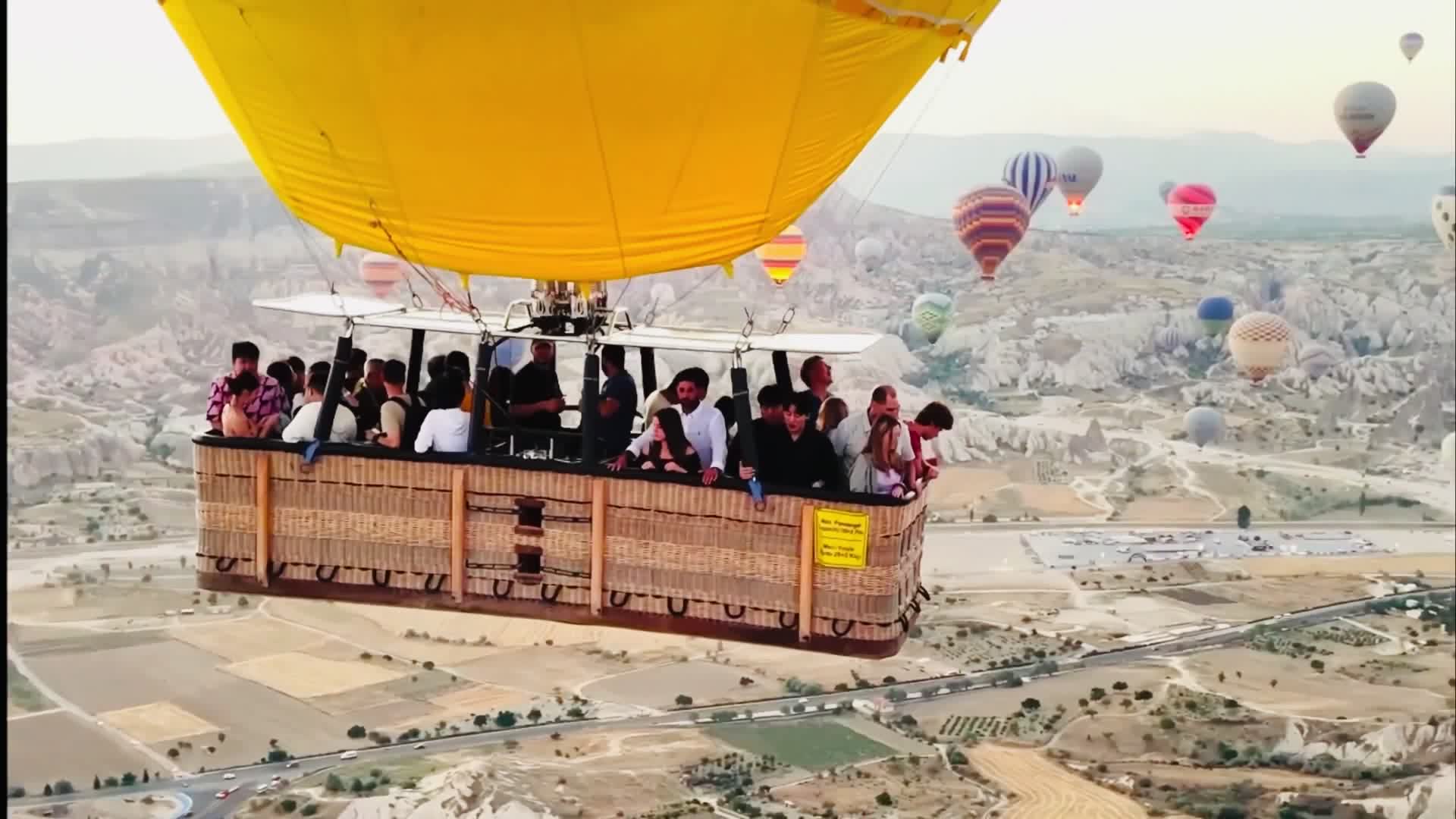
Yes, hot air balloon flights in Cappadocia operate under a formal civil aviation framework. Around 30 licensed operators and their commercially licensed pilots are subject to daily oversight by the Turkish Civil Aviation Authority (SHGM) and its regional office SHM Kapadokya. No flight takes off without official clearance based on weather and flight-area suitability. Passenger insurance is mandatory. Balloons undergo annual airworthiness inspections. Like any aviation activity, ballooning is not risk-free, but the layered regulatory system is designed to reduce avoidable risk at a scale of roughly 770,000 passengers a year.
Safety is not a marketing category; it is an operational one. When travelers ask whether Cappadocia balloon flights are safe, they deserve a factual answer, not reassurance wrapped in promotional language.
Hot Air Cappadocia Balloon has operated under Tayf Tours DMC, TURSAB licence number 2290, since 1999. Volkan Yirtimci, the company founder, started in Turkish tourism in 1993 and has spent more than 30 years in incoming operations, including building the Cappadocia balloon booking team from the ground up and developing relationships with the region's most trusted licensed operators. Over 26 years of customer-facing operations, the team has personally accompanied thousands of guests through the booking and operations process.
This guide does not minimize incidents that have occurred in the region's history, and it does not promise more certainty than the operation can honestly deliver. What it does is explain exactly who regulates the activity, what criteria govern each go or no-go decision, how the insurance and licensing actually work, and the one safety action that every passenger holds in their own hands. Thirteen consecutive TripAdvisor Travelers' Choice awards, from 2013 through 2025, reflect consistent operational quality; they are mentioned here as context, not as a substitute for the factual explanation that follows.
Hot air ballooning in Cappadocia is regulated commercial aviation, not adventure tourism with a discretionary safety layer. The Turkish Directorate General of Civil Aviation, known by its abbreviation SHGM (Sivil Havacilik Genel Mudurlugu), provides the legal framework. The regional arm that handles Cappadocia specifically is SHM Kapadokya.
What the framework actually requires is specific. Every operator must hold a valid SHGM operator licence. Every commercial balloon pilot must hold a commercial balloon pilot licence with minimum logged flight hours. Balloons must pass annual airworthiness inspections and carry mandatory safety equipment: a fire extinguisher, a first aid kit, a drop line, and GPS tracking. Every operator must carry passenger and third-party liability insurance. Operating without those elements is not a legal option, and the authority enforces compliance.
The daily flight clearance is issued through a layered chain. SHGM sets the overall legal framework and operational standards. SHM Kapadokya reviews wind conditions, visibility, and ground factors and publishes the go or no-go status for each flight sector around midday on the day before. Operators receive that clearance, finalize their morning planning, and confirm pickup details with each guest by 18:00 the evening before the flight. Pilots then execute the flight within the parameters the authority has cleared, and retain safety authority for the flight itself: pre-flight briefing, takeoff, navigation, and landing.
What this structure means for a guest is that when you step into a basket, the flight has already passed through at least three independent checkpoints before you leave the ground.
Around 30 licensed balloon operators are currently authorized to fly in Cappadocia. The figure matters because it is small enough to allow meaningful regulatory oversight. Each operator's aircraft, personnel, and operational records are subject to inspection under SHGM requirements.
Balloon envelope inspection covers the fabric, load tape seams, and structural attachment points. Burner systems are inspected for fuel-line integrity and valve function. Baskets are inspected for structural soundness and load capacity markings. These are not self-certified checks; they are conducted against regulated airworthiness standards.
Pilot licensing sits on top of the aircraft inspection layer. A commercial balloon pilot licence in Turkey requires formal ground school, written examinations, a minimum number of logged flight hours, and a medical certificate. Beyond the licence, what matters most in Cappadocia specifically is in-region experience. Many of the most experienced Cappadocia pilots have accumulated over 3,000 hours of flying in this specific terrain, with its valley wind behavior, fairy chimney formations, and high traffic density on busy mornings. That depth of familiarity is one of the strongest safety factors in the operation, and it is almost entirely invisible to a guest who has never flown there before.
When you book through a licensed agency like Hot Air Cappadocia Balloon, operating under TURSAB licence number 2290, the partner operators you fly with have been selected through a vetting process built on years of regional working relationships, not simply on price.
Most serious incidents in global ballooning trace back to weather decisions that should have gone differently. The Cappadocia regulatory framework addresses this directly with conservative, externally enforced cancellation criteria.
The conditions that result in cancellation include surface wind speeds above the regulatory limit at the launch point, upper-level winds in directions that would push balloons toward terrain or restricted airspace, visibility reduced by fog or low cloud, active precipitation or freezing conditions, and thunderstorm activity in the broader area. These are not guidelines; they are operational requirements.
The annual flight-day cancellation rate in Cappadocia averages around 35 percent across all seasons. In August, the calmest month, cancellations drop to roughly 7 percent. In January, the most difficult month meteorologically, cancellations rise above 70 percent. That variability is not a sign of unreliable operators; it is the regulator applying consistent standards to genuinely different conditions.
When SHM Kapadokya closes the flight area for a given sector, every operator in that sector cancels. There is no version of this where one company flies and another does not on the same morning under the same conditions. A morning cancellation is rare after the official day-before clearance is issued, but remains possible if conditions shift suddenly after 18:00.
For guests, the practical implication is to book the balloon flight on the first available morning of your Cappadocia stay rather than the last. A cancellation early in your trip leaves room for rescheduling; a cancellation on your final morning does not. If the flight is cancelled due to weather, we move bookings to the next available morning where possible, and issue a full refund if rescheduling is not feasible.
Cappadocia balloon pilots are commercially licensed aviation professionals, not recreational hobbyists. A commercial balloon pilot licence in Turkey requires formal training, written examinations, and a minimum number of logged flight hours before the pilot is authorized to carry paying passengers.
The terrain they operate in is more demanding than it looks from the ground. Cappadocia valleys channel wind in ways that differ from open-field flying. Fairy chimney formations require precise altitude control. On a busy morning, 100 or more balloons may share the same sunrise window, requiring radio coordination and disciplined spatial awareness. The pilots who have spent 10, 15, or 20 years flying these specific valleys read morning wind behavior in ways that accumulated regional experience provides and no amount of general licence training can substitute.
Every flight begins with a mandatory pre-flight passenger briefing conducted by the pilot. The briefing covers what to expect during inflation, takeoff, and flight, but the single most important element is the landing position instruction. Passengers are shown how to face the direction of travel, hold the interior straps with both hands, bend their knees, and stay low until the pilot gives the all-clear after touchdown. This position is not ceremonial; it absorbs impact, maintains stability if the basket tips during a faster landing, and reduces the risk of injury during the one phase of the flight where conditions can be least predictable.
Following the briefing exactly is the one safety contribution a passenger makes directly. The pilot, the operator, the regulator, and the insurance all have roles in the system; the passenger's role is to listen carefully to this briefing and execute it when called.
The vast majority of cancellations happen at the authorization stage the day before, not once passengers are airborne. The official clearance process is designed to prevent flights from beginning in conditions that cannot safely complete.
If conditions shift during a flight, the pilot has the authority and the training to manage an unscheduled landing. Cappadocia's landscape offers numerous open fields suitable for balloon landings beyond the designated launch and landing zones. Every flight is tracked from the ground by a chase crew in radio contact with the pilot, with vehicles that can reach any landing point in the region. The mandatory on-board equipment includes GPS tracking, which allows the ground crew to locate the balloon in real time regardless of where it lands.
Pilot training covers emergency procedures including rapid descents, controlled deflations, and coordination with the ground crew under compressed timelines. In a region where weather monitoring is rigorous and the authority's conservative clearance standards mean flights only operate in a defined safe window, the mid-flight scenario is the rarest safety concern, but the infrastructure and training for it exist precisely because "rare" does not mean "never".
If a guest has a medical situation during a flight, the ground crew can coordinate with local emergency services. Cappadocia's balloon zone is well-known to local emergency responders, and a coordinated response can reach any reasonable landing point in the region.
The safety question visitors bring to Cappadocia ballooning sometimes covers the broader destination as well. Cappadocia as a tourist destination is one of the safest regions in Turkiye for international visitors. The area around Goreme, Urgup, Uchisar, and the wider Nevsehir province is a well-established, well-policed international tourism zone.
The pre-dawn departure routine specific to balloon flights adds a few practical notes worth mentioning. Pickup from hotels in the Goreme, Urgup, Uchisar, Cavusin, Avanos, Mustafapasa, and Nevsehir areas is included in the booking. Guests receive their exact pickup time by 18:00 the evening before the flight. Transfer vehicles are organized and labeled; there should be no reason to approach an unlabeled vehicle or an individual approaching you unsolicited in the street offering a balloon flight.
The launch field area, at first light, is an active operational zone. Following the ground crew's directions during inflation and boarding is part of safe behavior in that space. Guests who have mobility limitations that would prevent climbing into a basket, standing throughout the flight, or following the landing position instruction should contact us before booking to confirm whether the flight is appropriate.
Cappadocia itself has relatively little street-level safety concern by international standards. Normal travel awareness applies: keep valuables secure, stay on marked paths in valley hike areas, and confirm transportation arrangements in advance. The overall destination safety picture is favorable for the kind of traveler who plans carefully, which describes most of the guests who travel for a balloon flight experience.
Hot Air Cappadocia Balloon has received TripAdvisor Travelers' Choice recognition every year from 2013 through 2025, thirteen consecutive years. The award reflects consistent guest satisfaction across more than a decade of operation, built on verified guest reviews on TripAdvisor and on our own booking pages.
What that record reflects is genuine: guests who booked through our team, flew with our partner operators, and reported their experience afterward, consistently rated the result highly. Over 26 years, the accumulation of those reviews represents a real operational record.
What the awards do not reflect is immunity from risk. No award replaces the factual information about regulatory structure, weather cancellation policy, and insurance that any traveler researching this activity should understand before booking. The awards are mentioned here once, in this context, because that is where they belong: as one signal among several, weighted alongside TURSAB licensing, SHGM operator compliance, EUREKO Sigorta passenger insurance coverage up to 40,000 euros per passenger, and the on-the-ground operational discipline that has run the same way every morning for more than two decades.
A guest doing serious pre-booking research should read the regulatory sections of this guide and the deep-dive articles linked below. The award streak is the endorsement of those thousands of guests who already did.
A detailed breakdown of flight statistics, SHGM regulatory requirements, pilot licensing standards, insurance coverage, and the single safety action every passenger controls.
An honest look at destination safety in Cappadocia covering transportation, the tourist zone environment, and practical notes for international visitors arriving for a balloon flight.
A clear explanation of the weather cancellation process: how decisions are communicated, how rescheduling works, and what refund protections apply when the flight cannot proceed.
Minimum age 4, no upper age limit, no published weight cutoff, pregnancy excluded. The rules as they are actually applied, and what to mention at booking.
from EUR 119
60-min sunrise flight, 28-32 guests per basket. Our most-booked.
Check availability